No runtime dependencies
The server uses Node's built-in HTTP and SQLite modules (Node 22.13+), so there's nothing extra to install or keep updated.
A feelings journal inspired by Inside Out. Pick how you feel, write the story, and keep it as a glowing memory orb on your shelf — with private accounts backed by a real server.
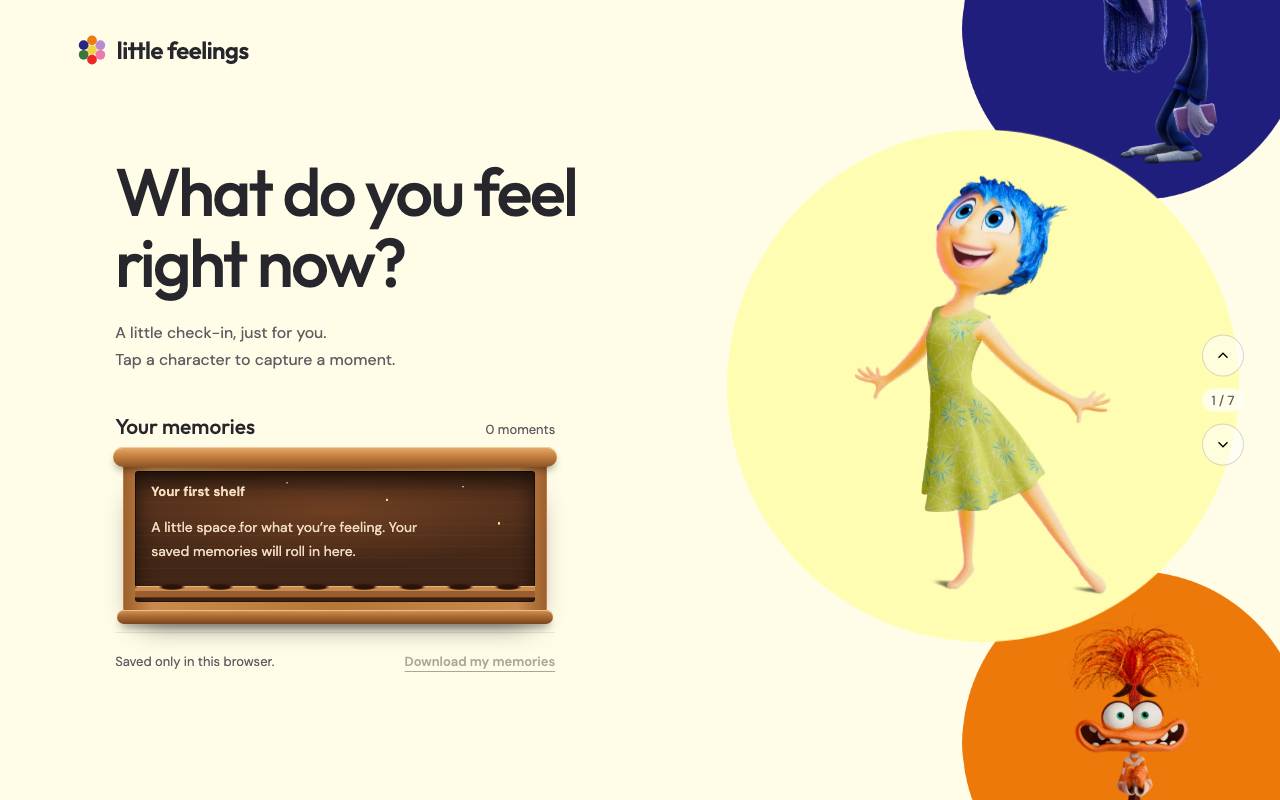
Guest mode. This preview runs the browser-only journal. Accounts, photo storage, and sync need the Node.js server, which GitHub Pages can't run.
Most mood trackers feel like forms. I wanted checking in to feel playful: a rotating wheel of characters where the one in the center is the feeling you choose, a short note, and a memory that rolls onto a wooden shelf.
It starts as a browser-only guest journal, and grows into private accounts so memories and photos survive across devices and server restarts.
The server uses Node's built-in HTTP and SQLite modules (Node 22.13+), so there's nothing extra to install or keep updated.
Passwords use salted scrypt hashes, only hashed session tokens are stored, and sessions live in HTTP-only, SameSite=Strict cookies.
Modifying requests need a CSRF token and the exact site origin. Sign-in endpoints are rate-limited.
Uploads are checked against real file signatures, stored in the database, and served only to their owner.
Imports run as one transaction, skip duplicates when retried, and roll back if anything goes wrong.
A Dockerfile, a health endpoint, and a one-command database snapshot make it straightforward to host and back up.
Integration tests cover authentication, private memory and photo access, CSRF and origin checks, image validation, editing, import rollback and duplicates, pagination, insights, backups, restart persistence, deletion, logout, and rate limiting. CI runs them on Node 22 and 24.
Not yet included: email verification and password-recovery mail. Character artwork belongs to Disney/Pixar and is used for a personal, non-commercial prototype.
A debugging-first way to learn CSS, with 48 playable cases.
Read the case study