Difficulty in color and shape
Each level has a trail-blaze color and a sign shape: circle, square, diamond, double diamond. Difficulty never depends on color alone.
Joiner hikes in the Philippines live in long Facebook posts and get booked one DM at a time. TrailPeak turns those posts into trips you can search, compare, and reserve with a down payment, and gives organizers one place to run them.
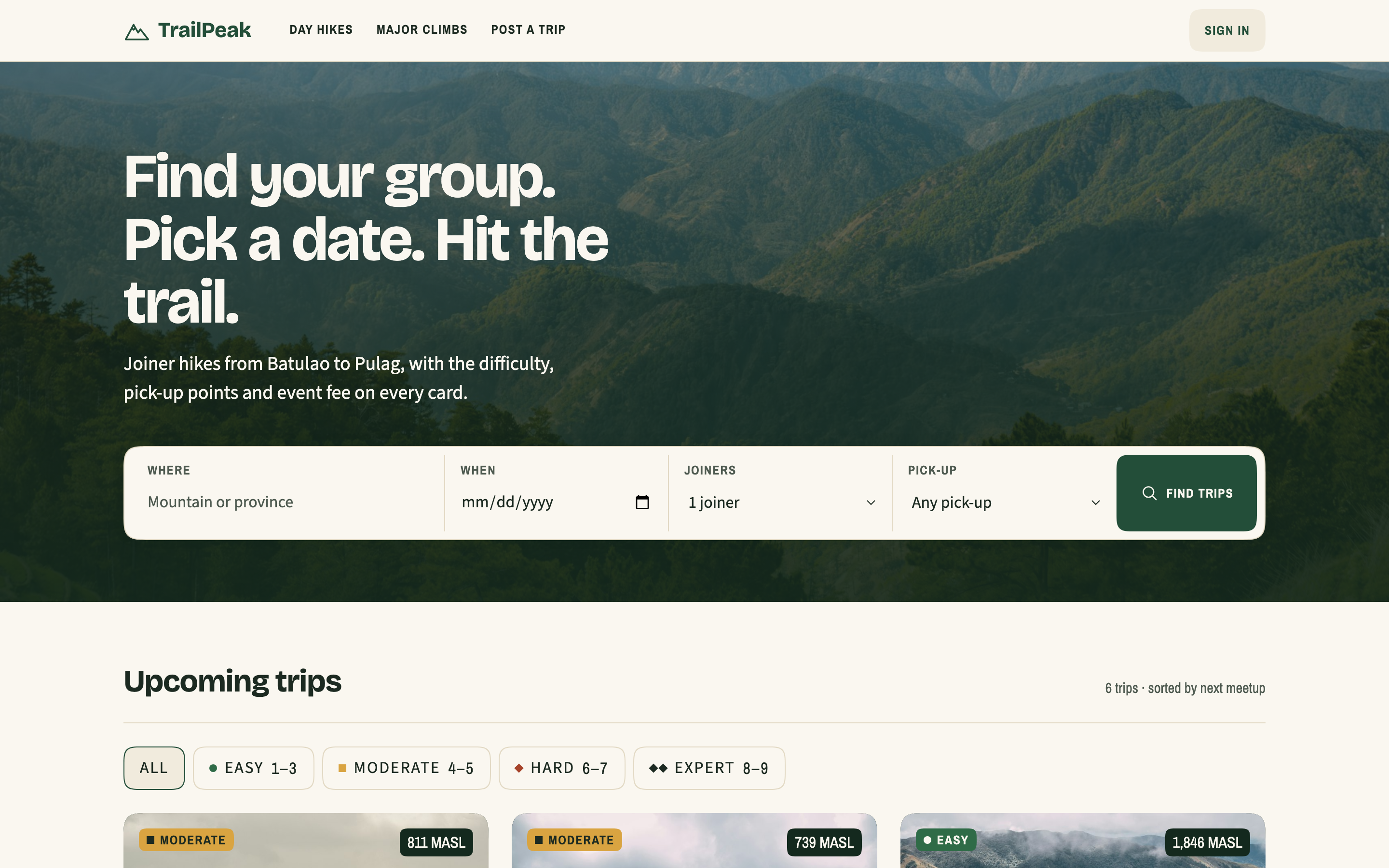
Before designing anything, I read 27 recent posts in Hiking Club Philippines, a public Facebook group with about 148,000 members. Organizers already post the same information every time, but by hand, so joiners can't search or compare anything.
I kept the words and numbers local hikers already use instead of inventing new ones.
Each level has a trail-blaze color and a sign shape: circle, square, diamond, double diamond. Difficulty never depends on color alone.
Lake blue means availability and nothing else. Slots left are stated calmly, with no red "book na bago maagawan" urgency.
Every trip shows the event fee and the DP. Organizers must list what's not included before they can publish.
Moving a date is free once, 7+ days before. Cancelling always says first that the DP won't be refunded, and offers the free move instead.
Colors, type and components are written down as one system before any screen was built, so every page matches. Rounded corners nest neatly inside each other.
Organizers post once and copy clean Facebook text with a link. Their dashboard shows slots per date, a joiner checklist and DP payouts.
Zero overbookings is the pilot's main promise, and the hardest part to get right. A reservation holds slots for 6 hours (2 when the trip is within 3 days) while the joiner sends their DP to the organizer. TrailPeak is a static site on Supabase with no server running timers, so a hold has to expire even when nobody has the page open.
I made "does this booking still hold its seats?" a calculation instead of a stored flag. One database function answers it from the current time, and every slot count uses it, so search, trip pages and the organizer dashboard always agree. A scheduled job only updates the labels.
Then a race test on a real Postgres database, running requests at the same instant, found two holes: a late DP reference could overbook a date (4 seats taken on a date with 2), and a double-click could create two reservations. The fix was three rules for every function that touches seats: lock the date before the booking, judge deadlines by the real clock after the lock, and give each submit one request ID.
Checked by race tests against Postgres 16 that run on every pull request. Decisions and trade-offs: hold expiry ↗ · concurrency rules ↗ · race test ↗
I audited every page of the front end against WCAG 2.1 AA with an automated scan and keyboard-only use, and fixed all 13 issues it found. That checks a lot, but not everything: it isn’t a full conformance claim, and screen readers haven’t been tested yet. Focus rings now stay visible on the dark booking panel, form errors are announced and move focus to the problem, every control is at least 44px, and numbers carry words for screen readers, like "Difficulty 4/9".
Where it stands: accounts, trips and bookings are real and stored in Supabase. TrailPeak doesn’t move money: joiners pay the DP to the organizer directly, and the organizer records it. ID checks and text messages are simulated and labeled "Demo". Next: a VoiceOver test, interviews with organizers and joiners ↗, and an assisted pilot with 3–5 organizers.
A cocktail bar landing page where the scroll tells the story.
Read the case study